
Skiing on a Snowy Day: Flat Light, Fresh Snow and Wind
Which lens gives the slope its shape back, how to read the poles when you can't see a thing, how to ski powder and what shuts down in the wind. The day beginners dread and veterans wait for.
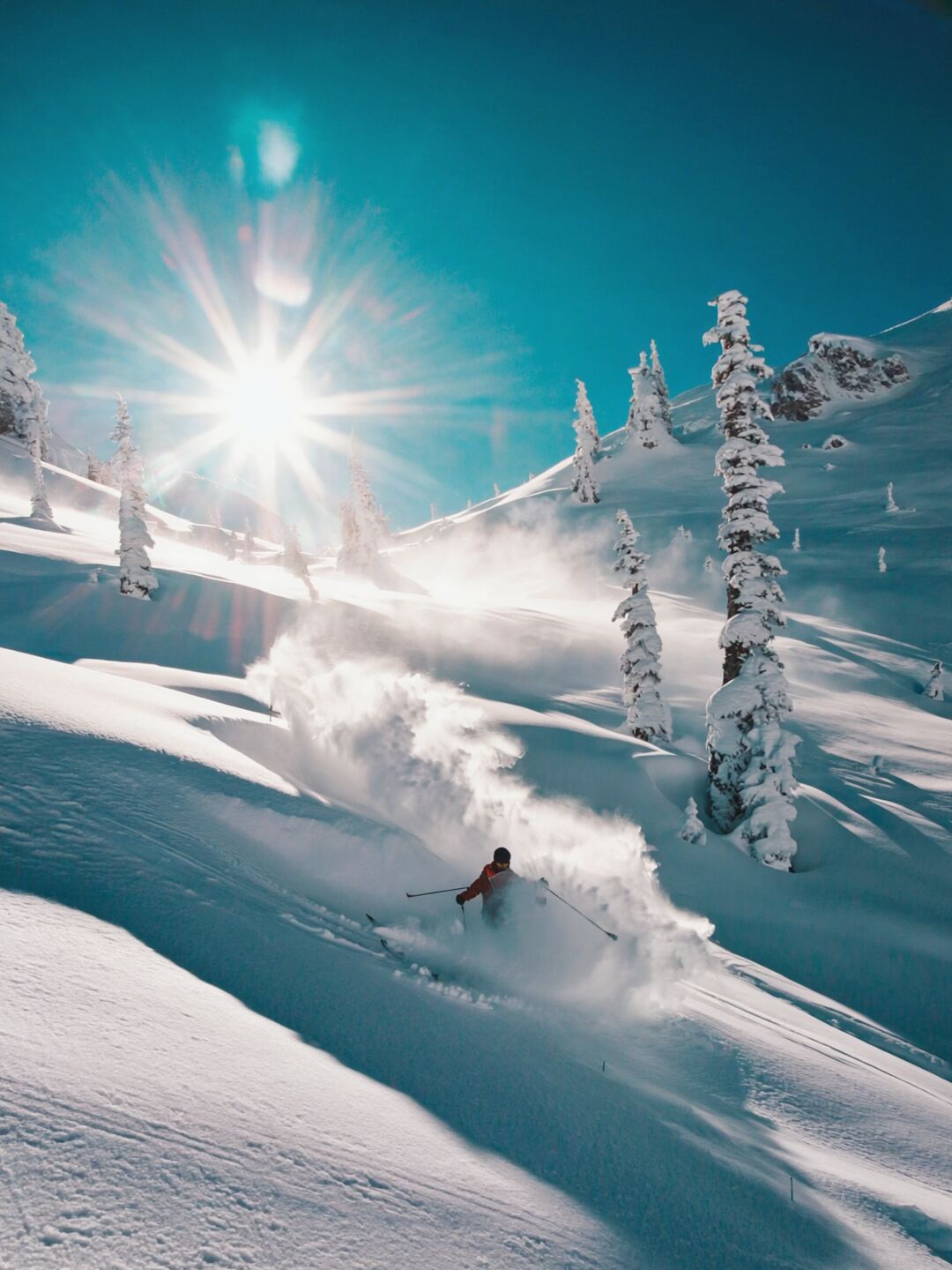
A day with snow falling is a good ski day, provided you switch to a bright lens, head down to the lower, tree-lined areas, ski pole to pole and in pairs, and cover every centimeter of skin. A bad day is only strong wind with zero visibility and deep cold — and then the lifts are closed anyway. There's a day like this almost every ski week: in the morning the beginners look out the window and see a disaster, while the veterans in the dining room eat fast and rush to the lift, because it's a powder day. Both are right.
In short:
- A bright lens (category 1), yellow, amber or pink
- Head down to the slopes among the trees
- Ski pole to pole, in pairs, the stronger skier in front
- In fresh snow: centered weight, skis together, keep your speed
- Zero exposed skin, and check each other's faces on every lift
Why can't you see the slope on an overcast day?
On a clear day the sun casts shadows, and those shadows reveal every bump and change of gradient to the eye. On an overcast day the light scatters through the cloud, there are no shadows and no contrast between snow and snow, and the slope turns into one uniform white surface. You're skiing inside a glass of milk, and the bump you didn't see knocks you down. In the Dolomites this is especially strong up high: the Belvedere plateau and the Pordoi pass are above the tree line, with nothing dark for the eye to latch onto.
Four solutions, in order:
- The lens. A dark lens turns an overcast day into night. For a day like this you need a bright lens, category 1, yellow, amber or pink. The color boosts contrast and gives the snow its shape back. If you don't have one, buy one at the resort shop. The best-value purchase of the week.
- The trees. On the Ciampac and Buffaure side, facing Alba, and on the lower slopes down to Canazei, the trees give the eye reference points and visibility improves dramatically. A storm day is a day for the lower areas, not the summits. The wind there is weaker too.
- The poles. Alongside every groomed slope there are poles in the slope's color, and in Italy they follow a rule most tourists don't know: the glowing orange band is long on the poles to the right of the slope (facing downhill) and short on the poles to the left. When you can't see a thing, ski pole to pole, don't stray from between them, and if the long band is on your right, you're heading the right way.
- In pairs, and slowly. The stronger skier goes first, within three or four poles' width, then stops and waits. The beginner skis after them and reads the terrain from their movement. Short turns, low speed, centered weight, and never lean back "to be careful." That's what makes you fall.
How do you ski in fresh snow?
Someone who learned on groomed slopes and hits 15 centimeters of soft snow for the first time feels like the skis are getting stuck. They're not stuck, they're floating, and you have to let them: equal weight on both skis, which work as one surface; an upright, centered stance, not back; keep your speed, because soft snow slows you down and speed is what keeps you on top of it; round, slow turns, rhythm not force. Start at the edge of the slope, where the fresh snow lies over a groomed base. And then you'll understand why the veterans ate fast.
And on the night that follows, some 300 groomers run over the 1,200 kilometers of Dolomiti Superski, leaving the corduroy pattern you see in the morning. On a day when more than ten centimeters fell overnight you get both the fresh and the groomed, and whoever went to bed early is out first.
Why do they close the lifts in the wind?
Because gondolas and chairs on a single cable start to sway in a crosswind of 50 to 65 kilometers per hour, and strong gusts stop them even sooner. A crosswind is worse than a headwind, and exposed lifts on a ridge are the first to close. That same morning the heavy lifts — first among them the Alba–Col dei Rossi lift near the hotel, of the most wind-resistant kind — are usually still running. Which lift survives which wind, in the lift guide. On a stormy morning, check the Dolomiti Superski board of open lifts, ask our team at breakfast, pick an area based on what's open, and don't climb to the summit "just to see."
Cold
On a day with wind and minus ten, the feels-like temperature can drop to minus twenty, and at temperatures like these exposed skin gets damaged within ten to thirty minutes. The signs: a sharp cold, then numbness and tingling, and skin that turns white or gray-pale. The Canadian rule: the buddy check. You look at each other's nose and cheeks on every lift, and anyone with a white patch goes inside immediately, warms it with their hands or lukewarm water — not rubbing. A face mask or a collar pulled up to the goggles, hand warmers in your gloves, and a break every hour to hour and a half: step into a lift station or sit on the terrace of a hut with the food you brought from the hotel. Children on a day like this: two hours in the morning, a long warm-up, and if they come back out, only to the little slope. What to wear so there's no exposed skin, in the clothing guide.
When shouldn't you go out to ski?
When strong wind, zero visibility and deep cold come together. Then you don't ski and you don't feel bad about it: pool, spa, a lesson, sleep, and the Alba ice rink within walking distance. The avalanche flags at the lift stations only concern anyone venturing off the marked slopes; on the groomed slopes, which are checked and opened every morning, they don't apply to you. And the next day, when the sun returns and 30 fresh centimeters lie on the mountain, it's the best day of the week. What the snow is like today, in the Canazei snow report.
Is it snowing during your week and you're not sure what to do with the kids? Talk to us at Har Tayarut.
Which ski goggle lens for an overcast day?
A bright lens, category 1, in yellow, amber or pink. It boosts contrast and gives the slope its shape back. A dark lens (category 3) turns an overcast day into night.
Why do they close the lifts in the wind?
Chairs and gondolas on a single cable sway in a crosswind of 50 to 65 km/h, and exposed lifts are the first to close. Large cable cars and funifor lifts, like Alba–Col dei Rossi, are far more resistant.
What do you do at a ski resort on a storm day?
If it's only snowing, ski low among the trees with a bright lens. If there's also strong wind and zero visibility, the lifts are closed anyway: pool, spa, sleep, the ice rink, and the next day — the powder day.
Live webcams from the resort
All magazine posts · To the kosher ski vacation · To the kosher summer vacation · Har Tayarut