
The Lift Guide: How to Ride Every Type Without Embarrassment
Magic carpet, button lift, chairlift, gondola, large aerial tram and funifor: how each one works, how to get on and off, what shuts down first in the wind, and what you'll find right by the hotel.
Ski lifts come in four families: surface lifts (magic carpet, button lift, T-bar) where you stay on the snow; chairlifts; gondolas, where your skis go into an outside holder; and large aerial trams (cable cars, funifor, 3S) that hold up in the wind. A beginner on day one rides the magic carpet and the button lift, and the chairlift with the instructor. The scariest part for beginners isn't coming down but getting on, so here they are in order, from simplest to most complex, and how to ride each one like someone who's done it before.
Who rides what, in short:
- First time: magic carpet, then button lift. Chairs with the instructor
- Small children: chairs only between two adults, gondola no problem
- Non-skiers: gondola, large aerial tram, funifor. No skis required, the view is
- Afraid of heights: gondola, not chairs
- Snowboarders: chairs and gondolas are a breeze, button lift and T-bar are survival mode
- Stormy day: funifor, 3S, large aerial trams, and bubbles in a low-lying area
Surface lifts
The magic carpet. A slow rubber conveyor belt you stand on with your skis and ride up. The lift of the first lesson and the snow garden: short and slow, but you can't fall off it, and suitable from age three.
The button lift (Poma). A pole hanging from a cable with a disc at its end that you tuck between your legs, and it pulls you up the slope while your skis stay on the snow. This is not a seat: anyone who tries to sit on the disc falls. Grab the pole, let it pull you, soft knees, look ahead. The first pull is surprising, and for snowboarders it's a challenge, they ride with the back foot released. Children usually manage it from around age five or six, and on the first few goes a parent rides alongside on their own pole.
The T-bar. Same idea, but a T-shaped bar ridden in pairs, each person with half the bar behind the thigh. It requires coordination between the two riders, and a child and an adult of different heights makes it hard; if one falls, both go down. Today it's mainly found on glaciers and in beginner areas.
Chairlift
The chair comes from behind, you sit down, and it carries you up through the air with your skis on. There are two kinds. Fixed-grip: the chair is permanently attached to the cable, so the whole cable moves slowly to let you get on. Slow, cold, and the chair hits you hard on boarding; the Sadzele lift in Gudauri, for example, climbs to the summit in about 13 minutes in the wind. Detachable: the chair detaches from the cable at the station, slowing almost to a stop so you board comfortably, then clamps back onto a cable moving twice as fast. Smooth boarding, short ride, expensive, so only on the busy lines. The bubble and heated seat are an upgrade of the detachable: a plastic dome you pull down over your head, and sometimes a heated seat. In wind and snow it's a world of difference. On the Belvedere above Canazei the Cristianìa–Col dei Rossi lift is one of these, and in Gudauri it's most of the new lifts.
How do you get on a chairlift?
Take your hand out of the pole strap and hold both poles in one hand; backpack on your knees. Stand at the "wait" line, move up to the "go" line once the chair ahead of you has left, look back at the chair coming, and sit well back. Once you've left the station, lower the safety bar, and say so out loud to your neighbors.
How do you get off a chairlift?
Before the top station, check that no scarf or strap is caught. Raise the bar only at the sign that indicates it. Ski tips up. Stand as the chair reaches the ramp, glide straight ahead, and clear the area right away, there's a chair behind you. Couldn't get off? Don't jump. Stay seated, a safety gate stops the lift.
What do you do if the lift stops?
Stay seated, even if the chair is close to the ground. Never get down. Stops of a minute or two are routine, someone fell while boarding. A rope evacuation is a very rare event, and it's carried out by the rescue crew, chair by chair.
The rule for children in Italy: a child under 1.25 meters, or under the age of eight, does not ride a chairlift alone. The accompanying adult lowers and raises the bar, and the child sits between two adults. In France and Georgia the rule is different, and your instructor will tell you. How this fits into a family week.
Gondola
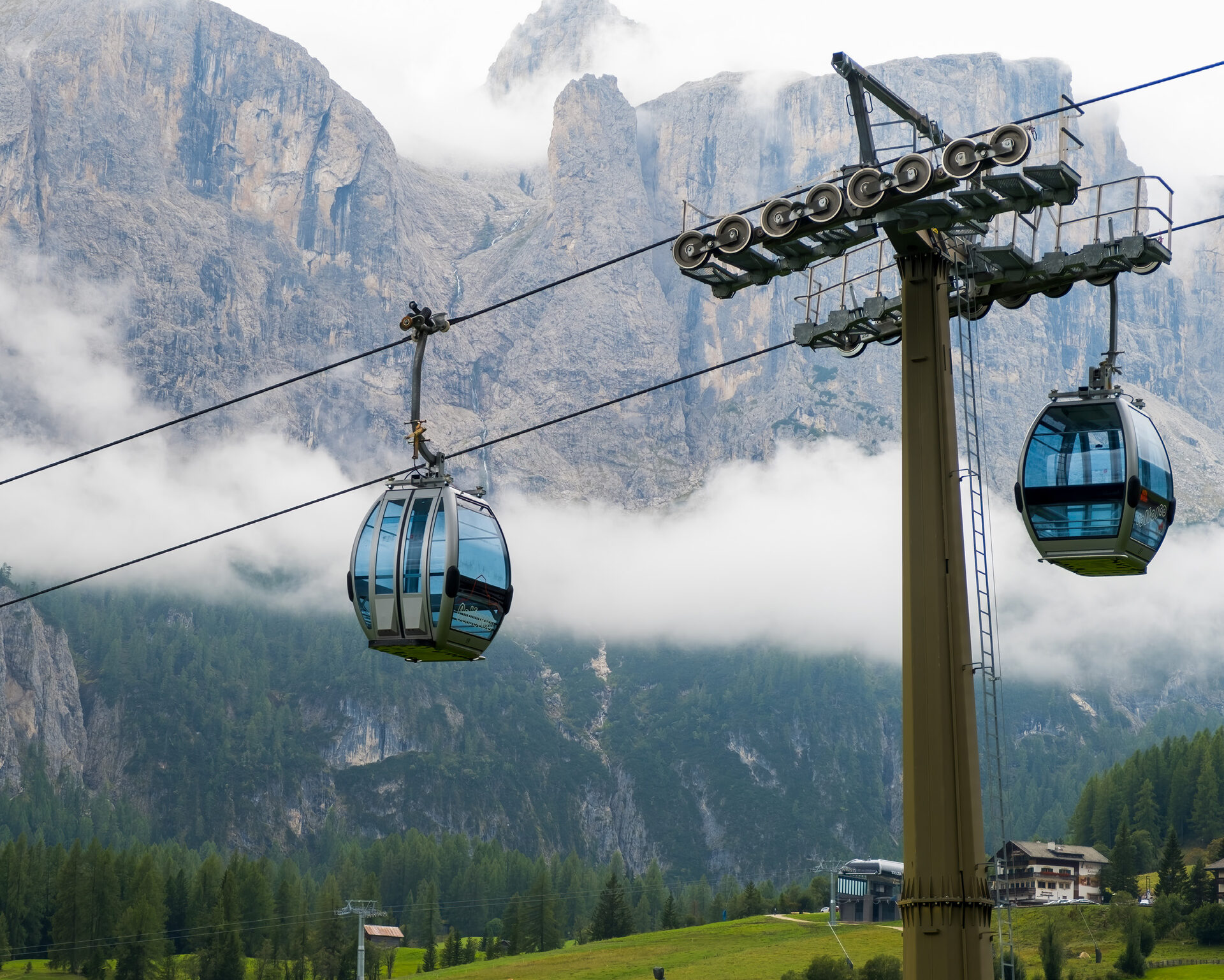
A closed cabin for six to ten passengers that detaches from the cable at the station and moves slowly to let you board. You take off your skis and place them in the external holder on the cabin's side; a snowboard goes inside or into the holder. Warm, dry, you can talk, and suitable also for non-skiers: grandma, a toddler in a stroller, anyone going up for the view. In a crowded line with skis in hand it's awkward, and in a storm the cabins sway and shut down.
From the kosher hotel in Alba you walk out to the Alba–Ciampac lift, a ten-passenger gondola, about six and a half minutes up to 2,149 meters, with no morning bus. From the center of Canazei the Canazei–Pecol lift goes up. And in La Plagne, the new gondola to Roche de Mio and the glacier cable car that climbs to 3,080 meters, with two open cabins for six harnessed passengers for anyone who wants to go up without windows (La Plagne).
Large aerial tram (cable car)
Two large cabins, 50 to 200 passengers, that travel opposite each other on a carrying cable: as one goes up the other comes down and balances it. It crosses chasms without pylons, holds up in the wind, and is very fast, but it departs on a schedule rather than continuously, so the line is long, you stand packed together, and it has a sense of height that isn't pleasant for everyone. Those who are afraid stand in the middle, not by the window. In the Dolomites: the Sass Pordoi cable car from the Belvedere plateau to the "Terrace of the Dolomites" at 2,950 meters, and the three Marmolada cable cars up to Punta Rocca, 3,265 meters. In La Plagne: the Vanoise Express, the double-decker 200-passenger cabin that crosses the valley to Les Arcs at 45 kilometers per hour without a single pylon, and feels like standing in a room.
Funifor
A rare type: a single large cabin on two carrying cables set far apart, which keeps it from swaying side to side. The result: a lift that works in winds that shut down everything else. One of the few in Italy is the Alba–Col dei Rossi lift, close to the hotel: 100 passengers, 883 meters of climb in five minutes, straight to the Sella Ronda. On a stormy day, when the gondolas stand still, this is usually the lift still running, and that's another reason to stay in Alba. From the same wind-resistant family: 3S lifts, large gondolas on three cables, and last season one of these opened near Canazei, the new Campitello–Col Rodella lift for 30 passengers.
What shuts down in the wind, and in what order
Chairlifts and ordinary gondolas start to close in a crosswind of 50 to 65 kilometers per hour, and short gusts stop them even earlier. A crosswind is more dangerous than a headwind. The typical order: first the high, exposed chairlifts, then the gondolas, and last the large aerial trams, the funifor and the 3S. On a stormy day you ski the low-lying areas served by heavy aerial trams, and you check in the morning on the Dolomiti Superski open-lifts board or ask our team at breakfast. What else to do on a day like that.
A question about the lifts near your hotel? Talk to us at Har Tayarut.
How do you ride a button lift?
Tuck the disc between your legs, grab the pole, let it pull you and stay standing with soft knees. Don't sit on the disc, your skis stay on the snow the whole way.
Can a child ride a chairlift alone in Italy?
Not under the age of eight or under 1.25 meters. They ride between two adults, and the adult lowers and raises the safety bar.
What do you do if the chairlift stops?
Stay seated, even if the chair is close to the ground, and don't get down. Stops of a minute or two are routine. A rope evacuation is very rare, and it's carried out by the rescue crew.
All magazine posts · To the kosher ski vacation · To the kosher summer vacation · Har Tayarut